25. října 2013

Dialog

Překládat rozhovor mezi postavami je celkem snadné - pokud víte, kdo postavy jsou, jak uvažují, jak se vyjadřují. Každý člověk má svůj osobitý styl, a totéž čekáme i od literární postavy.
Proto máte tentokrát k dispozici text, jehož hrdiny velmi pravděpodobně dobře znáte. Pokuste se přeložit tučně vyznačenou část.
Tip: Přečtěte si hotový překlad nahlas, nebo požádejte někoho o spolupráci a celou scénu si přehrajte jako na divadle. Pokud se vám některé repliky špatně pamatují a špatně vyslovují, je s překladem pravděpodobně něco v nepořádku.

Stylové roviny v překladu

Harry Potter and the Goblet of Fire
CHAPTER EIGHTEEN - THE WEIGHING OF THE WANDS
When Harry woke up on Sunday morning, it took him a moment to remember why
he felt so miserable and worried. Then the memory of the previous night rolled
over him. He sat up and ripped back the curtains of his own four-poster, intending
to talk to Ron, to force Ron to believe him - only to find that Ron's bed was empty;
he had obviously gone down to breakfast.
Harry dressed and went down the spiral staircase into the common room. The
moment he appeared, the people who had already finished breakfast broke into
applause again. The prospect of going down into the Great Hall and facing the rest
of the Gryffindors, all treating him like some sort of hero, was not inviting; it was
that, however, or stay here and allow himself to be cornered by the Creevey
brothers, who were both beckoning frantically to him to join them. He walked
resolutely over to the portrait hole, pushed it open, climbed out of it, and found
himself face-to-face with Hermione.
"Hello," she said, holding up a stack of toast, which she was carrying in a napkin.
"I brought you this. . . . Want to go for a walk?"
"Good idea," said Harry gratefully.
They went downstairs, crossed the entrance hall quickly without looking in at the
Great Hall, and were soon striding across the lawn toward the lake, where the
Durmstrang ship was moored, reflected blackly in the water. It was a chilly
morning, and they kept moving, munching their toast, as Harry told Hermione
exactly what had happened after he had left the Gryffindor table the night before.
To his immense relief, Hermione accepted his story without question.
"Well, of course I knew you hadn't entered yourself," she said when he'd finished
telling her about the scene in the chamber off the Hall. "The look on your face
when Dumbledore read out your name! But the question is, who did put it in?
Because Moody's right, Harry... I don't think any student could have done it. . .
they'd never be able to fool the Goblet, or get over Dumbledore's -"
"Have you seen Ron?" Harry interrupted.
Hermione hesitated.
"Erm. . . yes. . . he was at breakfast," she said.
"Does he still think I entered myself?"
"Well. . . no, I don't think so . . . not really," said Hermione awkwardly.
"What's that supposed to mean, 'not really'?"
"Oh Harry, isn't it obvious?" Hermione said despairingly. "He's jealous!"
"Jealous?" Harry said incredulously. "Jealous of what? He wants to make a prat of
himself in front of the whole school, does he?"
"Look," said Hermione patiently, "it's always you who gets all the attention, you
know it is. I know it's not your fault," she added quickly, seeing Harry open his
mouth furiously. "I know you don't ask for it.. . but - well - you know, Ron's got
all those brothers to compete against at home, and you're his best friend, and
you're really famous - he's always shunted to one side whenever people see you,
and he puts up with it, and he never mentions it, but I suppose this is just one time
too many. . .
"Great," said Harry bitterly. "Really great. Tell him from me I'll swap any time he
wants. Tell him from me he's welcome to it.... People gawping at my forehead
everywhere I go. . ."
"I'm not telling him anything," Hermione said shortly. "Tell him yourself. It's the
only way to sort this out."
"I'm not running around after him trying to make him grow up!" Harry said, so
loudly that several owls in a nearby tree took flight in alarm. "Maybe he'll believe
I'm not enjoying myself once I've got my neck broken or -"
"That's not funny," said Hermione quietly. "That's not funny at all." She looked
extremely anxious. "Harry, I've been thinking - you know what we've got to do,
don't you? Straight away, the moment we get back to the castle?"
"Yeah, give Ron a good kick up the -"
"Write to Sirius. You've got to tell him what's happened. He asked you to keep
him posted on everything that's going on at Hogwarts. . . . It's almost as if he
expected something like this to happen. I brought some parchment and a quill out
with me -"
"Come off it," said Harry, looking around to check that they couldn't be overheard,
but the grounds were quite deserted. "He came back to the country just because
my scar twinged. He'll probably come bursting right into the castle if I tell him
someone's entered me in the Triwizard Tournament -"
"He'd want you to tell him," said Hermione sternly. "He's going to find out
anyway."
"How?"
"Harry, this isn't going to be kept quiet," said Hermione, very seriously. "This
tournament's famous, and you're famous. I'll be really surprised if there isn't
anything in the Daily Prophet about you competing. . . . You're already in half the
books about You-Know-Who, you know.. . and Sirius would rather hear it from
you, I know he would."


11. října 2013

Jack London, námořník a dobrodruh

1. Přečtěte si začátek povídky Jacka Londona. Pokuste se charakterizovat jeho autorský styl - své názory napište do komentáře k tomuto blogu.
2. Vyhledejte v textu místa, která by mohla při překladu dělat potíže.
3. Přeložte tučně označený text.

Jack London: THAT DEAD MEN RISE UP NEVER

The month in which my seventeenth birthday arrived I signed on before the mast on the Sophie Sutherland, a three-topmast schooner bound on a seven-months’ seal-hunting cruise to the coast of Japan.  We sailed from San Francisco, and immediately I found confronting me a problem of no inconsiderable proportions.  There were twelve men of us in the forecastle, ten of whom were hardened, tarry-thumbed sailors.  Not alone was I a youth and on my first voyage, but I had for shipmates men who had come through the hard school of the merchant service of Europe.  As boys, they had had to perform their ship’s duty, and, in addition, by immemorial sea custom, they had had to be the slaves of the ordinary and able-bodied seamen.  When they became ordinary seamen they were still the slaves of the able-bodied.  Thus, in the forecastle, with the watch below, an able seaman, lying in his bunk, will order an ordinary seaman to fetch him his shoes or bring him a drink of water.  Now the ordinary seaman may be lying in his bunk.  He is just as tired as the able seaman.  Yet he must get out of his bunk and fetch and carry.  If he refuses, he will be beaten.  If, perchance, he is so strong that he can whip the able seaman, then all the able seamen, or as many as may be necessary, pitch upon the luckless devil and administer the beating.

My problem now becomes apparent.  These hard-bit Scandinavian sailors had come through a hard school.  As boys they had served their mates, and as able seamen they looked to be served by other boys.  I was a boy—withal with a man’s body.  I had never been to sea before—withal I was a good sailor and knew my business.  It was either a case of holding my own with them or of going under.  I had signed on as an equal, and an equal I must maintain myself, or else endure seven months of hell at their hands.  And it was this very equality they resented.  By what right was I an equal?  I had not earned that high privilege.  I had not endured the miseries they had endured as maltreated boys or bullied ordinaries.  Worse than that, I was a land-lubber making his first voyage.  And yet, by the injustice of fate, on the ship’s articles I was their equal.

My method was deliberate, and simple, and drastic.  In the first place, I resolved to do my work, no matter how hard or dangerous it might be, so well that no man would be called upon to do it for me.  Further, I put ginger in my muscles.  I never malingered when pulling on a rope, for I knew the eagle eyes of my forecastle mates were squinting for just such evidences of my inferiority.  I made it a point to be among the first of the watch going on deck, among the last going below, never leaving a sheet or tackle for some one else to coil over a pin.  I was always eager for the run aloft for the shifting of topsail sheets and tacks, or for the setting or taking in of topsails; and in these matters I did more than my share.

Furthermore, I was on a hair-trigger of resentment myself.  I knew better than to accept any abuse or the slightest patronizing.  At the first hint of such, I went off—I exploded.  I might be beaten in the subsequent fight, but I left the impression that I was a wild-cat and that I would just as willingly fight again.  My intention was to demonstrate that I would tolerate no imposition.  I proved that the man who imposed on me must have a fight on his hands.  And doing my work well, the innate justice of the men, assisted by their wholesome dislike for a clawing and rending wild-cat ruction, soon led them to give over their hectoring.  After a bit of strife, my attitude was accepted, and it was my pride that I was taken in as an equal in spirit as well as in fact.  From then on, everything was beautiful, and the voyage promised to be a happy one.


2. května 2013

Jak překládat povídku

1. Někdy je to těžší, než překládat román... proč asi?
2. V capse najdete dvě povídky Raye Bradburyho - The reincarnate a Murder. Vyberte si namátkou jednu z nich a zkuste přeložit pár vět ze začátku. Jaké problémy musíte řešit?

3. Vyhledejte v povídkách výrazy, v nichž bude třeba pečlivě volit z thesauru slovní zásoby.

...a jeden zajimavy odkaz!

18. dubna 2013

Nonsens v literatuře


Starší překlady:
http://prekladanipvk.blogspot.cz/2009_02_22_archive.html
http://prekladanipvk.blogspot.cz/2009/10/prekladatel-v-kraji-divu.html
http://prekladanipvk.blogspot.cz/2011/11/lysperni-jezleni-ti-druzi.html 

http://en.wikipedia.org/wiki/How_Doth_the_Little_Crocodile


CHAPTER II The Pool of Tears

“Curiouser and curiouser!” cried Alice (she was so much surprised, that for the moment she quite forgot how to speak good English). “Now, I'm opening out like the largest telescope that ever was! Good-bye. feet!" (for when she looked down at her feet, they seemed to be almost out of sight, they were getting so far off). “Oh. my poor little feet. I wonder who will put on your shoes and stockings for you now, dears? I’m sure I shan’t be able! I shall be a great deal too far off to trouble myself about you: you must manage the best way you can - but I must be kind to them”, thought Alice, “or perhaps they won’t walk the way I want to go! Let me see. I'll give
them a new pair of boots every Christmas.'’
And she went on planning to herself how she would manage it. “They must go by the earner." she thought: "and how funny it'll seem, sending presents to one's own feet! And how odd the directions will look!

Alice's Right Foot, Esq.
Hearthrug,
near the Fender,
(with Alice's love).

Oh dear, what nonsense I'm talking!“
Just at this moment her head struck against the roof of the hall: in fact she was now rather more than nine feet high, and she at once took up the little golden key and hurried off to the garden door.
Poor Alice! It was as much as she could do. lying down on one side, to look through into the garden with one eye: but to get through was more hopeless than ever: she sat down and began to cry again.
‘‘You ought to be ashamed of yourself.*’ said Alice, “a great girl like you”, (she might well say this). ‘*to go on crying in this way! Stop this moment. I tell you!*’ But she went on all the same, shedding gallons of tears, until there was a large pool around her. about four inches deep, and reaching half down the hall.

3. dubna 2013

Kouzlo vesmíru

Arthur C. Clarke. Isaac Asimov, Ray Bradbury.
To jsou tři králové zlatého věku science-fiction, spisovatelé fantazie, která se v mnoha případech stala běžnou realitou našeho dnešního života.

Asimovovy tři zákony robotiky jsou dodnes předmětem diskuse a sporů - mezi programátory a odborníky zabývajícími se vývojem umělé inteligence (AI). Nikdo už ovšem nediskutuje o prospěšnosti geostacionárních družic...  :) ale málokdo ví, že u jejich zrodu stál jeden mladý spisovatel.

A.C. Clarke byl odborným vzděláním fyzik a matematik, a náš život ovlivnil víc, než si myslíme:
Během druhé světové války sloužil v britském královském letectvu (RAF) jako instruktor pro práci s radarem. V říjnu 1945 otiskl v časopise Wireless World myšlenku, jak pomocí tří družic zajistit celosvětový příjem televizního signálu. Bohužel pro něj však je v Británii k udělení patentu potřeba dvou fungujících exemplářů vynálezu. Takto mohl jen v roce 1962, kdy se jeho myšlenka uskutečnila, publikovat v časopise článek Jak jsem přišel o miliardu dolarů vynalézáním Telstaru ve volném čase. Díky tomu je dnes známý jako vynálezce principu telekomunikační družice a na jeho počest je geostacionární oběžná dráha někdy nazývána Clarkova.
http://cs.wikipedia.org/wiki/Arthur_C._Clarke

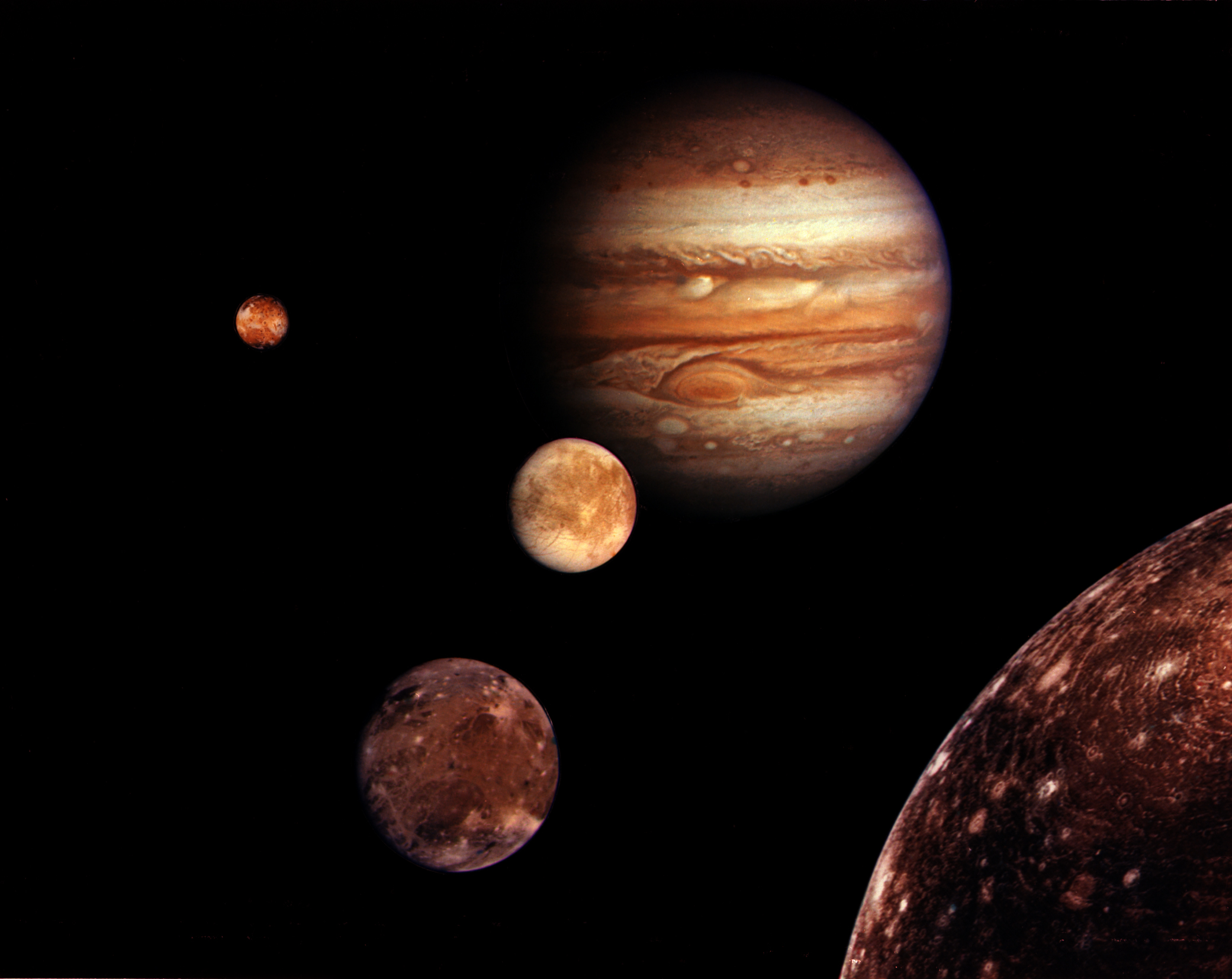
Jeho vědeckofantastické romány jsou podloženy hlubokou znalostí vesmíru a astronomie; je až překvapující, nakolik například jeho popisy blízkého pohledu na vzdálené planety a měsíce Sluneční soustavy odpovídají skutečnosti, zprostředkované o až desítky let později sondami NASA Galileo a Cassini (Huygens). Při překládání Clarkových děl je skutečně nutné chápat aspoň základní fyzikální zákony - a hlavně, ověřovat, ověřovat, ověřovat...

Ukázka je z románu snad úplně nejznámějšího: 2010: Vesmírná odyssea 2 (2010: Odyssey Two). Na chvíli se ocitneme v kosmické lodi ve vnějším pásmu Sluneční soustavy, v blízkosti plynného obra Jupitera.

Fulltext available here
Trailer
Jupiter ignition

More about Galilean satellites - NASA

Tipy:
1. seznámení s termíny
2. pochopení situace
3. vizualizace


The View from Lagrange
      Astronomy was full of such intriguing but meaningless coincidences. The most famous was the fact that, from the Earth, both Sun and Moon have the same apparent diameter. Here at the L.1 libration point, which Big Brother had chosen for its cosmic balancing act on the gravitational tightrope between Jupiter and Io, a similar phenomenon occurred. Planet and satellite appeared exactly the same size.
      And what a size! Not the miserable half-degree of Sun and Moon, but forty times their diameter - sixteen hundred times their area. ‘The sight of either was enough to fill the mind with awe and wonder; together, the spectacle was overwhelming.
      Every forty-two hours, they would go through their complete cycle of phases; when Io was new, Jupiter was full, and vice versa. But even when the Sun was hiding behind Jupiter and the planet presented only its nightside, it was unmistakably there - a huge black disk eclipsing the stars. Sometimes that blackness would be momentarily rent by lightning flashes lasting for many seconds, from electrical storms far larger than the Earth.
      On the opposite side of the sky, always keeping the same face toward its giant master, Io would be a sluggishly boiling cauldron of reds and oranges, with occasional yellow clouds erupting from one of its volcanoes, and falling swiftly back to the surface. Like Jupiter, but on a slightly longer time scale, Io was a world without geography. Its face was remodelled in a matter of decades - Jupiter’s, in a matter of days.
      As Io waned toward its last quarter, so the vast, intricately banded Jovian cloudscape would light up beneath the tiny, distant sun. Sometimes the shadow of Io itself, or one of the outer satellites, would drift across the face of Jupiter; while every revolution would show the planet-sized vortex of the Great Red Spot - a hurricane that had endured for centuries if not for millennia.
      Poised between such wonders, the crew of Leonov had material for lifetimes of research - but the natural objects of the Jovian system were at the very bottom of their list of priorities. Big Brother was Number 1; though the ships had now moved in to only five kilometres, Tanya still refused to allow any direct physical contact. ‘I’m going to wait,’ she said, ‘until we’re in a position to make a quick getaway. We’ll sit and watch - until our launch window opens. Then we’ll consider our next move.’
      It was true that Nina had finally grounded on Big Brother, after a leisurely fifty-minute fall. This had allowed Vasili to calculate the object’s mass as a surprisingly low 950,000 tons, which gave it about the density of air. Presumably it was hollow - which provoked endless speculation about what might be inside.
      But there were plenty of practical, everyday problems to take their minds off these greater issues. Housekeeping chores aboard Leonov and Discovery absorbed ninety per cent of their working time, though operations’ were much more efficient since the two ships had been coupled by a flexible docking connection. Curnow had finally convinced Tanya that Discovery’s carousel would not suddenly seize up and tear the ships to pieces, so it had become possible to move freely from one vessel to the other merely by opening and closing two sets of airtight doors. Spacesuits and time-consuming EVAs were no longer necessary - to the great delight of everyone except Max, who loved going outside and exercising with his broomstick.


13. března 2013

Soulad hudby a textu


Dokážete označit přízvučné slabiky v následujících textech?
Zkuste si text polohlasně zarecitovat, zadeklamovat, vcítit se do rytmu, který se v něm skrývá.


Hoj ty štědrý večere,
ty tajemný svátku,
cože komu dobrého
neseš na památku?


Znám křišťálovou studánku
kde nejhlubší je les
tam roste tmavé kapradí
a vůkol rudý vřes.


Pod tou skálou, kde proud řeky syčí,
tam kde ční červený kamení


From this valley they say you are going
We will miss your bright eyes and sweet smile
For they say you are taking the sunshine
That has brightened our pathways awhile


John Brown's body lies a-mouldering in the grave,
But his soul goes marching on.


Country roads, take me home
To the place I belong
West Virginia, mountain momma
Take me home, country roads

Veď mě dál cesto má
veď mě dál, vždyť i já
tam kde končíš chtěl bych  dojít
Veď mě dál cesto má


Oh when the saints go marching in
oh I’d want to be in that number
when the saints go marching in


Výběr písní k překladu do češtiny
  1. Queen – Bohemian rhapsody http://www.youtube.com/watch?v=fJ9rUzIMcZQ  (2 stanzas: mama… born at all)
  2. Sloop John B. http://www.youtube.com/watch?v=ubAjEjkJIJo
  3. Amazing grace http://www.youtube.com/watch?v=GYMLMj-SibU        text: http://www.pohodar.com/preklady/AmazingGrace.htm

Seznamte se nejprve se všemi navrženými písněmi - každá má úplně jiný charakter. Vyberte si tu, která je vám nejsympatičtější, a pokuste se o překlad. Nejste vůbec vázáni obsahem originálu! Jediné, covás limituje, je hudba.
Hudební a textové přízvuky by se měly překrývat, podobně jako dlouhé a krátké slabiky respektují dlouhé a krátké noty (není no totéž!).

28. února 2013

Jak nám zobák narost

Při překládání dialogů je dobré představit si jednající osoby, vědět, kdo jsou, jak se chovají, co je pro ně typické. Vizualizaci může doplnit další dobrá pomůcka: přečíst si hotový překlad nahlas. Pokud se čte špatně, nepřirozeně, je někde chyba :)

Dick Francis je autorem řady populárních detektivek. Jeho styl je rychlý, čtivý, sdělný a především velice přirozeně odráží běžnou spisovnou komunikaci v britské společnosti. Předložená ukázka z knihy Hot Money neskrývá prakticky žádné zásadní překladatelské nástrahy. Naším hlavním úkolem tedy bude soustředit se na plynulost dialogu.

Jako obyčejně si nejprve zjistěte pár základních údajů o autorovi, přečtěte si synopsi díla, a pak se pusťte do překládání tučně vyznačeného úryvku.


Dick Francis - Hot Money

Eight


‘Which door did you go out of, with the dogs?’ I asked.
The kitchen door, like I always do.’
‘The kitchen door is about five steps along that covered way from the rear door into the garage.’
‘Yes, of course it is,’ Malcolm said testily.
‘You told me that you set off down the garden with the dogs, and I suppose you told the police the same thing?
‘Yes, of course I did.’
‘But you can’t really remember actually going. You remember that you meant to, isn’t that what you told me?
He frowned. ‘I suppose it is.’
‘So what if you never made it to the garden, but were knocked out right there by the kitchen door? And what if you weren’t dragged from there into the garage, but carried?
His mouth opened. ‘But I’m ...’
‘You’re not too heavy,’ I said. ‘1 could carry you easily in a fireman's lift.’
He was five foot seven, stocky but not fat. He weighed ten stone something, I would have guessed.
‘And the fingerprints?’ Norman West asked.
‘In a fireman’s lift,’ I said, ‘you sling the person you want to carry over your left shoulder, don’t you, with his head hanging down your back. Then you grasp his knees with your left arm, and hold his right wrist in your own right hand, to stop him slipping off?’
They both nodded.
‘So if you’re holding someone’s wrist, you can put his hand easily onto any surface you like, including car door handles... particularly,’ I said, thinking, ‘if you’ve opened the doors yourself first with gloves on, so that your victim’s prints will be on top of any smudges you have made.’ ‘You should have been an assassin,’ Malcolm said. ‘You’d have been good at it.’
‘So now we have Malcolm slumped in the back seat, half lying, like you said. So next you switch on the engine and leave the doors open so that all the nice fumes pour into the car quickly.’
‘Doors?’ Malcolm interrupted.
‘The driver’s door and one of the rear doors, at the least.’
‘Oh, yes.’
‘And then you have,’ I said, ‘a suicide.’
‘And when I woke up,’ Malcolm said gloomily, ‘I put my prints all over the place. On the ignition key ... everywhere.’
‘No one could have counted on that.’
‘It just looked bad to the police.
We contemplated the scenario.
‘If it happened like that,’ West said, ‘as indeed it could have done, whoever attacked you had to know that you would go out of the kitchen door at around that time.’
Malcolm said bleakly, ‘If I’m at home, I always go for a walk with die dogs about then. Take them out, bring them back, give them their dinners, pour myself a drink. Routine.’
‘And ... er... is there anyone in your family who doesn’t know when you walk the dogs?’
‘Done it all my life, at that time,’ Malcolm said.
There was a short silence, then I said, ’I wish I’d known all this when that car nearly killed us at Newmarket. We really ought to have told the police.’ ’I was fed up with them,’ Malcolm said, ’I’ve spent hours and hours with die suspicious buggers since Moira’s death. I’m allergic to them. They bring me out in a rash.’
‘You can’t blame them, sir. Most murdered wives are killed by their husbands,’ West said. ‘And frankly, you appeared to have an extremely strong motive.’
‘Rubbish,’ Malcolm said. ‘I don’t see how people can kill people they’ve loved.’
‘Unfortunately it’s common.’ West paused. ‘Do you want me to continue with your family, sir, considering how little progress I’ve been able to make with them?’
‘Yes,’ Malcolm said heavily. ‘Carry on. I’ll get Joyce to tell them all to answer your questions. She seems to be able to get them to do what she wants.’
To get them to do what they want, I thought. She couldn’t stir them into courses they didn’t like.
Norman West put his notebook into his jacket pocket and shifted his weight forward on his chair.
‘Before you go,’ I said, ‘1 thought you might like to know that I asked the telephonist of the Cambridge hotel if anyone besides yourself had asked if a Mr Pembroke was staying there last weekend. She said they’d definitely had at least three calls asking for Mr Pembroke, two men and a woman, and she remembered because she thought it odd that no one wanted to talk to him, or would leave a message; they only wanted to know if he was there.’
'Three!’ Malcolm exclaimed.
‘One would be Mr West,’ I pointed out. To West, I said, ‘In view of that, could you tell us who asked you to find my father?’
West hesitated, ’I don't positively know which Mrs Pembroke it was. And… er... even if I became sure during these investigations, well, no sir, I don’t think I could.’
‘Professional ethics,’ Malcolm said, nodding.
I did warn you, sir,’ West said to me, ‘about a conflict of interests.’ ‘So you did. Hasn’t she paid you yet, then? No name on any cheque?’
‘No, sir’ not yet.’