3. prosince 2019

Klasická detektivka - Agatha Christie

Agatha Christie patří ke světovým klasikům detektivního žánru, a její hrdina, Belgičan Hercule Poirot, k nejslavnějším literárním detektivům. Jeho osobnost i řeč je výrazně specifická, a překladatel-nováček by se měl dobře seznámit jak s vývojem postavy, tak s náležitostmi  překladovými.

V následující ukázce poněkud schází Poirotovy obvyklé poznámky ve francouzštině. Ty jsou pro něho natolik charakteristické, že je rozhodně nebudeme převádět ani do češtiny, ani do jiného jazyka - ochudili bychom čtenáře o efekt autorkou pečlivě cizelovaný a systematicky používaný.

Příklady Poirotova osobitého vyjadřování, charakterizovaného drobnými gramatickými odchylkami a výstřelky v jeho vzletných promluvách, najdete třeba zde: https://prekladanipvk.blogspot.com/2011/10/v-risi-nemejskeho-lva.html
_______________________________________________________________
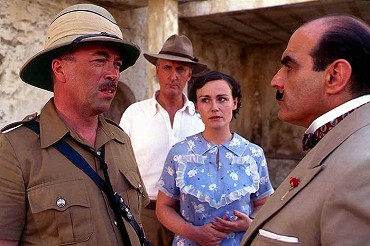
Image result for Murder in Mesopotamia suchet"


Agatha Christie
Murder in Mesopotamia

Chapter 27
Beginning of a Journey

‘Bismillahi ar rahman ar rahim. That is the Arab phrase used before starting out on a journey. Eh bien , we too start on a journey. A journey into the past. A journey into the strange places of the human soul.’

I don’t think that up till that moment I’d ever felt any of the so-called ‘glamour of the East’. Frankly, what had struck me was the mess everywhere. But suddenly, with M. Poirot’s words, a queer sort of vision seemed to grow up before my eyes. I thought of words like Samarkand and Ispahan—and of merchants with long beards—and kneeling camels—and staggering porters carrying great bales on their backs held by a rope round the forehead—and women with henna-stained hair and tattooed faces kneeling by the Tigris and washing clothes, and I heard their queer wailing chants and the far-off groaning of the water-wheel.

They were mostly things I’d seen and heard and thought nothing much of. But now, somehow they seemed different —like a piece of rusty old stuff you take into the light and suddenly see the rich colours of an old embroidery…

Then I looked round the room we were sitting in and I got a queer feeling that what M. Poirot said was true—we were all starting on a journey. We were here together now, but we were all going our different ways.

And I looked at everyone as though, in a sort of way, I were seeing them for the first time—and for the last time—which sounds stupid, but it was what I felt all the same.

Mr Mercado was twisting his fingers nervously—his queer light eyes with their dilated pupils were staring at Poirot. Mrs Mercado was looking at her husband. She had a strange watchful look like a tigress waiting to spring. Dr Leidner seemed to have shrunk in some curious fashion. This last blow had just crumpled him up. You might almost say he wasn’t in the room at all. He was somewhere far away in a place of his own. Mr Coleman was looking straight at Poirot. His mouth was slightly open and his eyes protruded. He looked almost idiotic. Mr Emmott was looking down at his feet and I couldn’t see his face properly. Mr Reiter looked bewildered. His mouth was pushed out in a pout and that made him look more like a nice clean pig than ever. Miss Reilly was looking steadily out of the window. I don’t know what she was thinking or feeling. Then I looked at Mr Carey, and somehow his face hurt me and I looked away. There we were, all of us. And somehow I felt that when M. Poirot had finished we’d all be somewhere quite different…

It was a queer feeling…
Poirot’s voice went quietly on. It was like a river running evenly between its banks…running to the sea…
‘From the very beginning I have felt that to understand this case one must seek not for external signs or clues, but for the truer clues of the clash of personalities and the secrets of the heart.
‘And I may say that though I have now arrived at what I believe to be the true solution of the case, I have no material proof of it . I know it is so, because it must be so, because in no other way can every single fact fit into its ordered and recognized place.
‘And that, to my mind, is the most satisfying solution there can be.’
He paused and then went on:
‘I will start my journey at the moment when I myself was brought into the case—when I had it presented to me as an accomplished happening. Now, every case, in my opinion, has a definite shape and form . The pattern of this case, to my mind, all revolved round the personality of Mrs Leidner. Until I knew exactly what kind of a woman Mrs Leidner was I should not be able to know why she was murdered and who murdered her.
‘That, then, was my starting point—the personality of Mrs Leidner.
‘There was also one other psychological point of interest—the curious state of tension described as existing amongst the members of the expedition. This was attested to by several different witnesses—some of them outsiders—and I made a note that although hardly a starting point, it should nevertheless be borne in mind during my investigations.
‘The accepted idea seemed to be that it was directly the result of Mrs Leidner’s influence on the members of the expedition, but for reasons which I will outline to you later this did not seem to me entirely acceptable.
‘To start with, as I say, I concentrated solely and entirely on the personality of Mrs Leidner. I had various means of assessing that personality. There were the reactions she produced in a number of people, all varying widely in character and temperament, and there was what I could glean by my own observation. The scope of the latter was naturally limited. But I did learn certain facts.
‘Mrs Leidner’s tastes were simple and even on the austere side. She was clearly not a luxurious woman. On the other hand, some embroidery she had been doing was of an extreme fineness and beauty. That indicated a woman of fastidious and artistic taste. From the observation of the books in her bedroom I formed a further estimate. She had brains, and I also fancied that she was, essentially, an egoist.
‘It had been suggested to me that Mrs Leidner was a woman whose main preoccupation was to attract the opposite sex—that she was, in fact, a sensual woman. This I did not believe to be the case.
‘In her bedroom I noticed the following books on a shelf: Who were the Greeks? ,Introduction to Relativity ,Life of Lady Hester Stanhope ,Back to Methuselah ,Linda Condon ,Crewe Train.
‘She had, to begin with, an interest in culture and in modern science—that is, a distinct intellectual side. Of the novels, Linda Condon , and in a lesser degree Crewe Train , seemed to show that Mrs Leidner had a sympathy and interest in the independent woman – unencumbered or entrapped by man. She was also obviously interested by the personality of Lady Hester Stanhope. Linda Condon is an exquisite study of the worship of her own beauty by a woman. Crewe Train is a study of a passionate individualist, Back to Methuselah is in sympathy with the intellectual rather than the emotional attitude to life. I felt that I was beginning to understand the dead woman.
‘I next studied the reactions of those who had formed Mrs Leidner’s immediate circle—and my picture of the dead woman grew more and more complete.
‘It was quite clear to me from the accounts of Dr Reilly and others that Mrs Leidner was one of those women who are endowed by Nature not only with beauty but with the kind of calamitous magic which sometimes accompanies beauty and can, indeed, exist independently of it. Such women usually leave a trail of violent happenings behind them. They bring disaster—sometimes on others—sometimes on themselves.
‘I was convinced that Mrs Leidner was a woman who essentially worshipped herself and who enjoyed more than anything else the sense of power . Wherever she was, she must be the centre of the universe. And everyone round her, man or woman, had got to acknowledge her sway. With some people that was easy. Nurse Leatheran, for instance, a generous-natured woman with a romantic imagination, was captured instantly and gave in ungrudging manner full appreciation. But there was a second way in which Mrs Leidner exercised her sway—the way of fear. Where conquest was too easy she indulged a more cruel side to her nature—but I wish to reiterate emphatically that it was not what you might call conscious cruelty. It was as natural and unthinking as is the conduct of a cat with a mouse. Where consciousness came in, she was essentially kind and would often go out of her way to do kind and thoughtful actions for other people.
‘Now of course the first and most important problem to solve was the problem of the anonymous letters. Who had written them and why? I asked myself: Had Mrs Leidner written them herself ?
‘To answer this problem it was necessary to go back a long way—to go back, in fact, to the date of Mrs Leidner’s first marriage. It is here we start on our journey proper. The journey of Mrs Leidner’s life.
‘First of all we must realize that the Louise Leidner of all those years ago is essentially the same Louise Leidner of the present time. ‘She was young then, of remarkable beauty—that same haunting beauty that affects a man’s spirit and senses as no mere material beauty can—and she was already essentially an egoist.
‘Such women naturally revolt from the idea of marriage. They may be attracted by men, but they prefer to belong to themselves. They are trulyLa Belle Dame sans Merci of the legend. Nevertheless Mrs Leidner did marry—and we can assume, I think, that her husband must have been a man of a certain force of character.
‘Then the revelation of his traitorous activities occurs and Mrs Leidner acts in the way she told Nurse Leidner. She gave information to the Government.
‘Now I submit that there was a psychological significance in her action. She told Nurse Leatheran that she was a very patriotic idealistic girl and that that feeling was the cause of her action. But it is a well-known fact that we all tend to deceive ourselves as to the motives for our own actions. Instinctively we select the best-sounding motive! Mrs Leidner may have believed herself that it was patriotism that inspired her action, but I believe myself that it was really the outcome of an unacknowledged desire to get rid of her husband! She disliked domination—she disliked the feeling of belonging to someone else—in fact she disliked playing second fiddle. She took a patriotic way of regaining her freedom.

‘But underneath her consciousness was a gnawing sense of guilt which was to play its part in her future destiny.

‘We now come directly to the question of the letters. Mrs Leidner was highly attractive to the male sex. On several occasions she was attracted by them—but in each case a threatening letter played its part and the affair came to nothing.

‘Who wrote those letters? Frederick Bosner or his brother William or Mrs Leidner herself ?
‘There is a perfectly good case for either theory. It seems clear to me that Mrs Leidner was one of those women who do inspire devouring devotions in men, the type of devotion which can become an obsession. I find it quite possible to believe in a Frederick Bosner to whom Louise, his wife, mattered more than anything in the world! She had betrayed him once and he dared not approach her openly, but he was determined at least that she should be his or no one’s. He preferred her death to her belonging to another man.

‘On the other hand, if Mrs Leidner had, deep down, a dislike of entering into the marriage bond, it is possible that she took this way of extricating herself from difficult positions. She was a huntress who, the prey once attained, had no further use for it! Craving drama in her life, she invented a highly satisfactory drama—a resurrected husband forbidding the banns! It satisfied her deepest instincts. It made her a romantic figure, a tragic heroine, and it enabled her not to marry again.

‘This state of affairs continued over a number of years. Every time there was any likelihood of marriage – a threatening letter arrived.

‘But now we come to a really interesting point. Dr Leidner came upon the scene—and no forbidding letter arrived! Nothing stood in the way of her becoming Mrs Leidner. Not until after her marriage did a letter arrive.
‘At once we ask ourselves—why?
‘Let us take each theory in turn.
…‘If Mrs Leidner wrote the letters herself the problem is easily explained. Mrs Leidner really wanted to marry Dr Leidner. And so she did marry him. But in that case, why did she write herself a letter afterwards? Was her craving for drama too strong to be suppressed? And why only those two letters? After that no other letter was received until a year and a half later.
‘Now take the other theory, that the letters were written by her first husband, Frederick Bosner (or his brother). Why did the threatening letter arrive after the marriage? Presumably Frederick could not have wanted her to marry Leidner. Why, then, did he not stop the marriage? He had done so successfully on former occasions. And why, having waited till the marriage had taken place , did he then resume his threats?
‘The answer, an unsatisfactory one, is that he was somehow or other unable to protest sooner. He may have been in prison or he may have been abroad.
‘There is next the attempted gas poisoning to consider. It seems extremely unlikely that it was brought about by an outside agency. The likely persons to have staged it were Dr and Mrs Leidner themselves. There seems no conceivable reason whyDr Leidner should do such a thing, so we are brought to the conclusion thatMrs Leidner planned and carried it out herself.

26. listopadu 2019

Songs

1. Znáte nějaké české verze původně anglických písní? Uveďte příklady v komentáři k blogu!

2. A jak se přeložené dílko proměňuje? Porovnejte:

Red river
Červená řeka

Three Ravens - A. Scholl
Three Ravens - Djazia
Three Ravens - vocal
Válka růží

L'important C'est la rose
Podívej, kvete růže

Všimněte si, jak se proměnilo i hudební provedení.

Další inspirace z oblasti téměř zlidovělé české popové klasiky zde - Ivo Fišer


I díla českých písničkářů jasně dokazují, že dobrý a vtipný text je silnou stránkou naší hudební scény.
Zuzana Navarová - Marie
Karel Kryl - Karavana mraků
Karel Plíhal - Nosorožec

Michal Tučný, Rattlesnake Annie - Long Black Limousine

My čekali jaro
... a zatím přišel mráz
Oh, dem golden slippers - parodie (info - WIKI)

Dobrodružství s bohem Panem
Greensleeves


3. Naším úkolem bude OTEXTOVAT píseň s původně anglickým textem. Nejsme nijak vázáni obsahem originálu, rozhoduje jedině forma, zpívatelnost - slovní a hudební přízvuky se musí překrývat. Zvolte si styl - a držte se ho, ať už to bude drama, lyrika nebo ostrá parodie.

Vyberte si jednu z níže uvedených tří skladeb a napište nový český text. Jediným kritériem je jeho ZPÍVATELNOST - měl by tedy respektovat rozložení přízvuků a délek v hudbě dle původní verze.

Country Roads-  John Denver
There is a ship - Peter, Paul and Mary
Seasons in the Sun  - Terry Jackson


12. listopadu 2019

Brel


Jsme dva má lásko
a milování směje se a zpívá
ale když den odeznívá
v kanafasu utrpení
je člověk zase sám.
Je nás deset, abychom bránili
živé před mrtvými
ale když člověka svým popelem přibili
ke kůlu výčitek
člověk je zase sám.
Je nás sto kteří tančíme
na plese dobrých kamarádů
ale při posledním lampiónu
při prvním smutku
je člověk zase sám.
Je nás tisíc proti tisíci
a věříme že jsme z těch silnějších
ale za pár hloupých hodin
kdy je z nás dva tisíce zabitých
je člověk zase sám.
Je nás sto tisíc a smějeme se sto tisícům
který nám stojí tváří v tvář
ale ani dva miliony smíchů
nezabrání aby v zrcadle a tichu
nebyl člověk zase sám.
Je nás tisíc a sedáme si
na samý vrchol štěstěny
ale když odvaha nás opouští
a za luny se všechno rozpouští
člověk je zase sám.
Je nás sto které sláva pozvala
aniž měla důvody
ale když umírají náhody
když píseň končí
je člověk zase sám.
Je nás deset a chceme
v posteli moci spát
ale když vidí její vojska
sama sebe v tichu pohřbívat
je člověk zase sám.
Jsme dva abychom zestárli
v boji s časem hlava nehlava
ale tváří v tvář když přichází
a směje se ta smrtka bělavá
je každý zase sám.

11. listopadu 2019

Shakespeare!


Jak překládat poezii?  A překládat ji vůbec? Má přednost forma či obsah? Dají se na překlad poesie aplikovat pravidla, o kterých jsme mluvili?


1. Projděte si komentáře k tomuto vstupu. Jaké typy básnické tvorby se objevují? Mají něco společného?

Dokážete se během 2 minut naučit 4 libovolné řádky zpaměti? Jak postupujete?


2. Stáhněte si z capsy soubor s různými verzemi překladu Shakespearova sonetu.
Shakespeare_Sonet66_13prekladu.doc

Která verze se vám nejvíc líbí? Proč? Napište svůj názor do komentáře k tomuto blogu. Uvažujete nad formou a obsahem nebo více nasloucháte svým pocitům?

Sonet 66 English
https://www.youtube.com/watch?v=4MWBW_c7Fsw

Sonet 66 Hilský
https://www.youtube.com/watch?v=SJw5BQba7zQ

Interview s Martinem Hilskym

__________________________________

3. Přečtěte si pomalu a klidně následující sonet. Vnímejte rytmus a zvukomalbu textu, při druhém čtení se teprve víc soustřeďte na obsah.

Sonnet XXV
Let those who are in favour with their stars
Of public honour and proud titles boast,
Whilst I, whom fortune of such triumph bars,
Unlook'd for joy in that I honour most.

Great princes' favourites their fair leaves spread
But as the marigold at the sun's eye,
And in themselves their pride lies buried,
For at a frown they in their glory die.

The painful warrior famoused for fight,
After a thousand victories once foil'd,
Is from the book of honour razed quite,
And all the rest forgot for which he toil'd:

Then happy I, that love and am beloved
Where I may not remove nor be removed.


Pokuste se přeložit jedno ze tří čtyřverší + poslání.
Rozmyslete si, jak budete postupovat.
audio
_______________________

originál
https://www.opensourceshakespeare.org/views/sonnets/sonnets.php

české překlady Shakespeara
Jan Vladislav-pdf
http://lukaflek.wz.cz/poems/ws_sonet29.htm
http://www.v-art.cz/taxus_bohemica/eh/bergrova.htm
http://www.shakespearovy-sonety.cz/a29/
Hilsky sonet 12 youtube
http://sonety.blog.cz/0803/william-shakespeare-sonnet-12-64-73-94-107-128-sest-sonetu-v-mem-prekladu


https://ucbcluj.org/current-issue/vol-21-spring-2012/2842-2/
http://mikechasar.blogspot.cz/2011/02/gi-jane-dh-lawrence.html

________________

https://lyricstranslate.com/en/sonnet-66-soneto-66.html

Soneto 66
Harto de todo esto, muerte pido y paz:
de ver cómo es el mérito mendigo nato
y ver alzada en palmas la vil nulidad
y la más pura fe sufrir perjurio ingrato

y la dorada honra con deshonra dada
y el virginal pudor brutalmente arrollado
y cabal derechura a tuerto estropeada
y por cojera el brío juvenil quebrado

y el arte amordazado por la autoridad
y el genio obedeciendo a un docto mequetrefe
y llamada simpleza la simple verdad
y un buen cautivo sometido a un triste jefe;

harto de todo esto; de esto huiría; sólo
que, al morir, a mi amor aquí lo dejo solo.

__________________

https://lyricstranslate.com/en/sonnet-66-shakespeare-sonett-66.html

Shakespeare: Sonett 66

Satt hab ich all dies, verlang im Tod den Frieden,
Seh ich, dass das Verdienst ein Bettler bleibt,
Dass nacktem Nichts das Festagskleid beschieden,
Dass Meineid reinste Treu ins Unglück treibt,
Dass Schande sich mit Ehrengold umhängt,
Dass Geilheit alles, was noch rein ist, schändet,
Dass Unrecht die Gerechtigkeit verdrängt,
Dass Stärke, durch Gewalt gelähmt, verkrüppelt,
Dass Macht dem Wissen fest die Zunge bindet,
Dass Dummheit kritisch Können überwacht,
Dass man die lautre Wahrheit lachhaft findet,
Dass Gut als Sklave dient der bösen Macht.
Satt hab' ich all dies, möcht' weg von alldem sein,
Doch wär' ich tot, ließ' ich mein Lieb allein.

https://shine.unibas.ch/Sonette1.htm#66
https://lyricstranslate.com/en/sonnet-66-sonett-66.html#songtranslation

__________________

Sonett 66

Des Todes Ruh' ersehn' ich lebensmüd,
Seh' ich Verdienst als Bettler auf der Welt,
Und leeres Nichts zu höchstem Prunk erblüht,
Und reinste Treue, die im Meineid fällt,
Und goldne Ehre, die die Schande schmückt,
Und Mädchenunschuld roh dahingeschlachtet,
Und Kraft durch schwache Leitung unterdrückt,
Und echte Hoheit ungerecht verachtet,
Und Kunst geknebelt durch die Übermacht,
Und Unsinn herrschend auf der Weisheit Thron,
Und Einfalt als Einfältigkeit verlacht,
Und Knecht das Gute in des Bösen Fron,
Ja lebensmüd entging' ich gern der Pein,
Ließ den Geliebten nicht mein Tod allein.

Übersetzt von Max Josef Wolff

https://lyricstranslate.com/en/sonnet-66-sonett-66.html-0#songtranslation

__________________

Sonett 66

Ich hab es satt. Wär ich ein toter Mann.
Wenn Würde schon zur Bettelei geborn
Und Nichtigkeit sich ausstaffieren kann
Und jegliches Vertrauen ist verlorn
Und Rang und Name Fähigkeit entbehrt
Und Fraun vergebens sich der Männer wehren
Und wenn der Könner Gnadenbrot verzehrt
Und Duldende nicht aufbegehren
Und Kunst gegängelt von der Obrigkeit
Und Akademiker erklärn den Sinn
Und simples Zeug tritt man gelehrsam breit
Und Gut und Böse biegt sich jeder hin
Ich hab es satt. Ich möchte wegsein, bloß:
Noch liebe ich. Und das läßt mich nicht los.

Deutsche Fassung von
Karl Werner Plath
__________________

Сонет 66

Измучась всем, я умереть хочу.
Тоска смотреть, как мается бедняк,
И как шутя живется богачу,
И доверять, и попадать впросак,

И наблюдать, как наглость лезет в свет,
И честь девичья катится ко дну,
И знать, что ходу совершенствам нет,
И видеть мощь у немощи в плену,

И вспоминать, что мысли заткнут рот,
И разум сносит глупости хулу,
И прямодушье простотой слывет,
И доброта прислуживает злу.

Измучась всем, не стал бы жить и дня,
Да другу будет трудно без меня.


Pasternak, Boris Leonidovic

__________________

Sonnet 66: Translation to modern English
Exhausted with the following things I cry out for releasing death: for example, seeing a deserving person who has been born into poverty; and an undeserving one dressed in the finest clothes; and someone who shows trustworthiness wretchedly betrayed; and public honour shamefully bestowed on the unfit; and unblemished goodness forced into bad ways; and genuine perfection unjustly disgraced; and conviction crippled by corruption; and skill suppressed by those with the power to do it; and stupidity restraining the advance of knowledge; and simple truth being dismissed as simplistic; and good taking orders from evil. Exhausted with all these things I want to escape, except that by dying I would be abandoning my love.

29. října 2019

Teenagerská literatura

Stephen Chbosky - The Perks of Being a Wallflower


May 8, 1992
Dear friend,
It's strange how things can change back as suddenly as they changed originally. When one thing happens and suddenly, things are back to normal.

On Monday, Brad came back to school.

He looked very different. It wasn't that he was bruised or anything. His face actually looked fine. But before, Brad was always this guy who walked down the hallway with a bounce. I can't really describe it any other way. It's just that some people walk with their heads to the ground for some reason. They don't like to look other people in the eye. Brad was never like that.
But now he is. Especially when it comes to Patrick. I saw them talking quiet in the hallway. I was too far away to hear what they said, but I could tell that Brad was ignoring Patrick. And when Patrick started to get upset, Brad just closed his locker and walked away. It wasn't that strange because Brad and Patrick never talked in school since Brad wanted things to be secret. The strange part was that Patrick would walk up to Brad in the first place. So, I guessed that they didn't meet on the golf courses anymore. Or talk on the phone even.

Later that afternoon, I was having a cigarette outside by myself, and I saw Patrick alone, also having a cigarette. I wasn't close enough to really see him, but I didn't want to interfere with his personal time, so I didn't walk up to him. But Patrick was crying. He was crying pretty hard. After that, whenever I saw him around anywhere, he didn't look like he was there. He looked like he was someplace else. And I think I knew that because that's how people used to say I was. Maybe they still do. I'm not sure.

On Thursday, something really terrible happened.

I was sitting alone in the cafeteria, eating salisbury steak, when I saw Patrick walk up to Brad, who was sitting with his football buddies, and I saw Brad ignore him like he did at the locker. And I saw Patrick get really upset, but Brad still ignored him. Then, I saw Patrick say something, and he looked pretty angry as he turned to walk away. Brad sat still for a second, then he turned around. And then I heard it. It was just loud enough for a few tables to hear. The thing that Brad yelled at Patrick.
"Faggot!"
Brad's football buddies start laughing. A few tables got quiet as Patrick turned around. He was mad as hell. I'm not kidding. He stormed up to Brad's table and said,
"What did you call me?"
God, he was mad. I'd never seen Patrick like that before. Brad sat quiet for a second, but his buddies kept egging him on by pushing his shoulders. Brad looked up at Patrick and said
softer and meaner than the last time, "I called you a faggot."
Brad's buddies started laughing even harder. That is, until Patrick threw the first punch. It's kind of eerie when a whole room gets quiet at once, and then the real noise starts. The fight was hard. A lot harder than the one I had with Sean last year. There was no clean punching or things you see in movies. They just wrestled and hit. And whoever was the most aggressive or the most angry got in the most hits. In this case, it was pretty even until Brad's buddies got involved, and it became five on one.
That's when I got involved. I just couldn't watch them hurt Patrick even if things weren't clear just yet. I think anyone who knew me might have been frightened or confused. Except maybe my brother. He taught me what to do in these situations. I don't really want to go into detail except to say that by the end of it, Brad and two of his buddies stopped fighting and just stared at me. His other two friends were lying on the ground. One was clutching the knee I bashed in with one of those metal cafeteria chairs. The other one was holding his face. I kind of swiped at his eyes, but not too bad. I didn't want to be too bad.

I looked down at the ground, and I saw Patrick. His face was pretty messed up, and he was crying hard. I helped him to his feet, and then I looked at Brad. I don't think we'd ever really exchanged two words before, but I guess this was the time to start. All I said was,
"If you ever do this again, I'll tell everyone. And if that doesn't work, I'll blind you."

I pointed at his friend who was holding his face, and I knew Brad heard me and knew that I meant it. He didn't say anything back, though, because the security guards of our school came to bring all of us out of the cafeteria. They took us first to the nurse, and then to Mr. Small. Patrick started the fight, so he was suspended for a week. Brad's buddies got three days each for ganging up on Patrick after they broke up the original fight. Brad wasn't suspended at all because it was self-defense. I didn't get suspended either because I was just helping to defend a friend when it was five on one.

Brad and I got a month's detention, starting that day.

In detention, Mr. Harris didn't set up any rules. He just let us read or do homework or talk. It really isn't much of a punishment unless you like the television programs right after school or are very concerned with your permanent record. I wonder if it's all a lie. A permanent record, I mean.
On that first day of detention, Brad came to sit next to me. He looked very sad. I think it all kind of hit him after he stopped feeling numb from the fight.
"Charlie?"
"Yeah?"
"Thanks. Thanks for stopping them."
"You're welcome."
And that was it.

14. října 2019

Stylové roviny


1. Projděte si opravné texty - překlad Melvilla. Vyhledejte výrazy, které do textu stylově nezapadají.

2. Ve skupinách (3-4) sepište co nejvíce výrazů více či méně synonymních ke slovům PES a VIDĚT. Soustřeďte se na vnímání jejich stylové platnosti - kam je vhodné který výraz zařadit? Která postava ho může použít a v jakém kontextu?

Nápověda:
výrazy archaické x neologismy
pejorativa x diminutiva
emočně negativní x pozitivní
slang a argot x odborná terminologie...


Série synonym najdete například zde:
http://prekladanipvk.blogspot.cz/2016/02/synonymie-stylove-roviny.html
http://prekladanipvk.blogspot.cz/2014/10/stylove-roviny.html