Tvoje stará pila leží ve sklepě.
Tvoje stará pila, leží ve sklepě.
Popravit, nelze udělit milost.
Popravit nelze, udělit milost.
Pojďme jíst, děti.
Pojďme jíst děti.
Co zas chcete, pane řediteli?
Co, zas chcete, pane řediteli?
Válku ne, mír!
Válku, ne mír!
19. března 2019

11. března 2019
Pygmalion

My Fair Lady - Audrey Hepburn, Rex Harris, 1964
https://www.youtube.com/watch?v=xmADMB2utAo
Ukázka s českými titulky
https://www.youtube.com/watch?v=VMjjF0OkiV8
Ukázka s anglickými titulky
https://www.youtube.com/watch?v=RMB_iyequy4
https://pygmalionstudyguide.weebly.com/glossary-of-terms.html
http://knihovnalubna.wz.cz/Povinn%C3%A1%20%C4%8Detba/Shaw-Pygmalion.pdf
_____________________________________
Představte si živě následující scénu. (vizualizace) Jakým stylem mluví jednotlivé postavy?
Zkuste nejprve přeložit Lizinu první větu ("Don't you be so saucy. You ain't heard what I come for
yet.") Vložte svou verzi do komentáře k blogu.
Vyhýbejte se vulgarismům, hledejte méně prvoplánové vyjadřovací prostředky. A pozor na jednotu stylu.
_____________________________________
The flower girl enters in state. She has a hat with three ostrich
feathers, orange, sky-blue, and red. She has a nearly clean apron, and
the shoddy coat has been tidied a little. The pathos of this deplorable
figure, with its innocent vanity and consequential air, touches
Pickering, who has already straightened himself in the presence of Mrs.
Pearce. But as to Higgins, the only distinction he makes between men
and women is that when he is neither bullying nor exclaiming to the
heavens against some featherweight cross, he coaxes women as a child
coaxes its nurse when it wants to get anything out of her.
HIGGINS [brusquely, recognizing her with unconcealed disappointment,
and at once, baby-like, making an intolerable grievance of it] Why,
this is the girl I jotted down last night. She's no use: I've got all
the records I want of the Lisson Grove lingo; and I'm not going to
waste another cylinder on it. [To the girl] Be off with you: I don't
want you.
THE FLOWER GIRL. Don't you be so saucy. You ain't heard what I come for
yet. [To Mrs. Pearce, who is waiting at the door for further
instruction] Did you tell him I come in a taxi?
MRS. PEARCE. Nonsense, girl! what do you think a gentleman like Mr.
Higgins cares what you came in?
THE FLOWER GIRL. Oh, we are proud! He ain't above giving lessons, not
him: I heard him say so. Well, I ain't come here to ask for any
compliment; and if my money's not good enough I can go elsewhere.
HIGGINS. Good enough for what?
THE FLOWER GIRL. Good enough for ye--oo. Now you know, don't you? I'm
come to have lessons, I am. And to pay for em too: make no mistake.
HIGGINS [stupent] WELL!!! [Recovering his breath with a gasp] What do
you expect me to say to you?
THE FLOWER GIRL. Well, if you was a gentleman, you might ask me to sit
down, I think. Don't I tell you I'm bringing you business?
HIGGINS. Pickering: shall we ask this baggage to sit down or shall we
throw her out of the window?
THE FLOWER GIRL [running away in terror to the piano, where she turns
at bay] Ah--ah--ah--ow--ow--ow--oo! [Wounded and whimpering] I won't be
called a baggage when I've offered to pay like any lady.
Motionless, the two men stare at her from the other side of the room,
amazed.
PICKERING [gently] What is it you want, my girl?
THE FLOWER GIRL. I want to be a lady in a flower shop stead of selling
at the corner of Tottenham Court Road. But they won't take me unless I
can talk more genteel. He said he could teach me. Well, here I am ready
to pay him--not asking any favor--and he treats me as if I was dirt.
MRS. PEARCE. How can you be such a foolish ignorant girl as to think
you could afford to pay Mr. Higgins?
THE FLOWER GIRL. Why shouldn't I? I know what lessons cost as well as
you do; and I'm ready to pay.
HIGGINS. How much?
THE FLOWER GIRL [coming back to him, triumphant] Now you're talking! I
thought you'd come off it when you saw a chance of getting back a bit
of what you chucked at me last night. [Confidentially] You'd had a drop
in, hadn't you?
HIGGINS [peremptorily] Sit down.
THE FLOWER GIRL. Oh, if you're going to make a compliment of it--
HIGGINS [thundering at her] Sit down.
MRS. PEARCE [severely] Sit down, girl. Do as you're told. [She places
the stray chair near the hearthrug between Higgins and Pickering, and
stands behind it waiting for the girl to sit down].
THE FLOWER GIRL. Ah--ah--ah--ow--ow--oo! [She stands, half rebellious,
half bewildered].
PICKERING [very courteous] Won't you sit down?
LIZA [coyly] Don't mind if I do. [She sits down. Pickering returns to
the hearthrug].
HIGGINS. What's your name?
THE FLOWER GIRL. Liza Doolittle.
HIGGINS [declaiming gravely]
Eliza, Elizabeth, Betsy and Bess,
They went to the woods to get a bird's nes':
PICKERING. They found a nest with four eggs in it:
HIGGINS. They took one apiece, and left three in it.
They laugh heartily at their own wit.
LIZA. Oh, don't be silly.
MRS. PEARCE. You mustn't speak to the gentleman like that.
LIZA. Well, why won't he speak sensible to me?
HIGGINS. Come back to business. How much do you propose to pay me for
the lessons?
LIZA. Oh, I know what's right. A lady friend of mine gets French
lessons for eighteenpence an hour from a real French gentleman. Well,
you wouldn't have the face to ask me the same for teaching me my own
language as you would for French; so I won't give more than a shilling.
Take it or leave it.
HIGGINS [walking up and down the room, rattling his keys and his cash
in his pockets] You know, Pickering, if you consider a shilling, not as
a simple shilling, but as a percentage of this girl's income, it works
out as fully equivalent to sixty or seventy guineas from a millionaire.
PICKERING. How so?
HIGGINS. Figure it out. A millionaire has about 150 pounds a day. She
earns about half-a-crown.
LIZA [haughtily] Who told you I only--
HIGGINS [continuing] She offers me two-fifths of her day's income for a
lesson. Two-fifths of a millionaire's income for a day would be
somewhere about 60 pounds. It's handsome. By George, it's enormous!
it's the biggest offer I ever had.
LIZA [rising, terrified] Sixty pounds! What are you talking about? I
never offered you sixty pounds. Where would I get--
HIGGINS. Hold your tongue.
LIZA [weeping] But I ain't got sixty pounds. Oh--
MRS. PEARCE. Don't cry, you silly girl. Sit down. Nobody is going to
touch your money.
HIGGINS. Somebody is going to touch you, with a broomstick, if you
don't stop snivelling. Sit down.
LIZA [obeying slowly] Ah--ah--ah--ow--oo--o! One would think you was my
father.
HIGGINS. If I decide to teach you, I'll be worse than two fathers to
you. Here [he offers her his silk handkerchief]!
LIZA. What's this for?
HIGGINS. To wipe your eyes. To wipe any part of your face that feels
moist. Remember: that's your handkerchief; and that's your sleeve.
Don't mistake the one for the other if you wish to become a lady in a
shop.
Liza, utterly bewildered, stares helplessly at him.
4. března 2019
Stylové roviny

Pokuste se napsat úvodní odstavec, cca 3-4 věty, popisující setkání hlavních jednajících postav. Soustřeďte se na jazykové prostředky, které použijete.
Vložte své texty do komentářů.
________________
2. Ve skupinách (3-4) sepište co nejvíce výrazů více či méně synonymních ke slovu DŮM. Soustřeďte se na vnímání jejich stylové platnosti - kam je vhodné který výraz zařadit? Která postava ho může použít a v jakém kontextu?
Nápověda:
výrazy archaické x neologismy
pejorativa x diminutiva
emočně negativní x pozitivní
slang a argot x odborná terminologie...
3. Kombinujte různé předpony se slovesem JÍT. Registrujte a popisujte změny významu i stylové platnosti.
Vložte své nápady do komentáře k tomuto blogu.
Série synonym najdete například zde:
http://prekladanipvk.blogspot.cz/2016/02/synonymie-stylove-roviny.html
http://prekladanipvk.blogspot.cz/2014/10/stylove-roviny.html
25. února 2019
Robinson Crusoe

2. Co je v textu zajímavé, zvláštní, obtížné? Vypište si námořnické termíny, vyhledejte a oveřte nejprve jejich smysl, pak teprve překlad.
3. Přečtěte si celý text ještě jednou. Vnímejte jeho strukturu, rytmus, pravidelnost a logiku.
4. Přeložte obě vyznačené části a překlad vložte do komentáře k tomuto blogu.
_______________________________________
The next day I made another voyage, and now, having plundered the ship of what was portable and fit to hand out, I began with the cables. Cutting the great cable into pieces, such as I could move, I got two cables and a hawser on shore, with all the ironwork I could get; and having cut down the spritsail-yard, and the mizzen-yard, and everything I could, to make a large raft, I loaded it with all these heavy goods, and came away. But my good luck began now to leave me; for this raft was so unwieldy, and so overladen, that, after I had entered the little cove where I had landed the rest of my goods, not being able to guide it so handily as I did the other, it overset, and threw me and all my cargo into the water. As for myself, it was no great harm, for I was near the shore; but as to my cargo, it was a great part of it lost, especially the iron, which I expected would have been of great use to me; however, when the tide was out, I got most of the pieces of the cable ashore, and some of the iron, though with infinite labour; for I was fain to dip for it into the water, a work which fatigued me very much. After this, I went every day on board, and brought away what I could get.
I had been now thirteen days on shore, and had been eleven times on board the ship, in which time I had brought away all that one pair of hands could well be supposed capable to bring; though I believe verily, had the calm weather held, I should have brought away the whole ship, piece by piece. But preparing the twelfth time to go on board, I found the wind began to rise: however, at low water I went on board, and though I thought I had rummaged the cabin so effectually that nothing more could
be found, yet I discovered a locker with drawers in it, in one of which I found two or three razors, and one pair of large scissors, with some ten or a dozen of good knives and forks: in another I found about thirty-six pounds value in money—some European coin, some Brazil, some pieces of eight, some gold, and some silver.
I smiled to myself at the sight of this money: “O drug!” said I, aloud, “what art thou good for? Thou art not worth to me—no, not the taking off the ground; one of those knives is worth all this heap; I have no manner of use for thee—e’en remain where thou art, and go to the bottom as a creature whose life is not worth saying.” However, upon second thoughts I took it away; and wrapping all this in a piece of canvas, I began to think of making another raft; but while I was preparing this, I found the sky overcast, and the wind began to rise, and in a quarter of an hour it blew a fresh gale from the shore. It presently occurred to me that it was in vain to pretend to make a raft with the wind offshore; and that it was my business to be gone before the tide of flood began, otherwise I might not be able to reach the shore at all. Accordingly, I let myself down into the water, and swam across the channel, which lay between the ship and the sands, and even that with difficulty enough, partly with the weight of the things I had about me, and partly the roughness of the water; for the wind rose very hastily, and before it was quite high water it blew a storm.
But I had got home to my little tent, where I lay, with all my wealth about me, very secure. It blew very hard all night, and in the morning, when I looked out, behold, no more ship was to be seen! I was a little surprised, but recovered myself with the satisfactory reflection that I had lost no time, nor abated any diligence, to get everything out of her that could be useful to me; and that, indeed, there was little left in her that I was able to bring away, if I had had more time.
I now gave over any more thoughts of the ship, or of anything out of her, except what might drive on shore from her wreck; as, indeed, divers pieces of her afterwards did; but those things were of small use to me.
My thoughts were now wholly employed about securing myself against either savages, if any should appear, or wild beasts, if any were in the island; and I had many thoughts of the method how to do this, and what kind of dwelling to make—whether I should make me a cave in the earth, or a tent upon the earth; and, in short, I resolved upon both; the manner and description of which, it may not be improper to give an account of.
https://www.sailing.cz/file/ERS-2009cz.pdf
http://www.alena36.xf.cz/typyoplachteni.htm
http://www.minisail.cz/inspirace/velke-lode/id:4630/oplachteni-lodi
18. února 2019
Jack London Continued
1. Projděte si opravené texty. pokuste se identifikovat společné problémy.
2. Víc hlav víc ví - vytvořte dvojice a společně zapracujte na opravě svých textů. Opravené texty vložte do komentářů k PŘEDCHOZÍMU BLOGOVÉMU VSTUPU - pod text originálu.
3. Dočtěte si závěr povídky a opět ve dvojicích přeložte vyznačené části. Překlady vložte do komentářů k tomuto blogovému vstupu a podepište jmény obou spoluautorů.
Though the hunger pangs were no longer so exquisite, he realized that he
was weak. He was compelled to pause for frequent rests, when he attacked
the muskeg berries and rush-grass patches. His tongue felt dry and
large, as though covered with a fine hairy growth, and it tasted bitter
in his mouth. His heart gave him a great deal of trouble. When he had
travelled a few minutes it would begin a remorseless thump, thump, thump,
and then leap up and away in a painful flutter of beats that choked him
and made him go faint and dizzy.
In the middle of the day he found two minnows in a large pool. It was
impossible to bale it, but he was calmer now and managed to catch them in
his tin bucket. They were no longer than his little finger, but he was
not particularly hungry. The dull ache in his stomach had been growing
duller and fainter. It seemed almost that his stomach was dozing. He
ate the fish raw, masticating with painstaking care, for the eating was
an act of pure reason. While he had no desire to eat, he knew that he
must eat to live.
_____________
He followed the trail of the other man who dragged himself along, and
soon came to the end of it--a few fresh-picked bones where the soggy moss
was marked by the foot-pads of many wolves. He saw a squat moose-hide
sack, mate to his own, which had been torn by sharp teeth. He picked it
up, though its weight was almost too much for his feeble fingers. Bill
had carried it to the last. Ha! ha! He would have the laugh on Bill. He
would survive and carry it to the ship in the shining sea. His mirth was
hoarse and ghastly, like a raven's croak, and the sick wolf joined him,
howling lugubriously. The man ceased suddenly. How could he have the
laugh on Bill if that were Bill; if those bones, so pinky-white and
clean, were Bill?
He turned away. Well, Bill had deserted him; but he would not take the
gold, nor would he suck Bill's bones. Bill would have, though, had it
been the other way around, he mused as he staggered on.
He came to a pool of water. Stooping over in quest of minnows, he jerked
his head back as though he had been stung. He had caught sight of his
reflected face. So horrible was it that sensibility awoke long enough to
be shocked. There were three minnows in the pool, which was too large to
drain; and after several ineffectual attempts to catch them in the tin
bucket he forbore. He was afraid, because of his great weakness, that he
might fall in and drown. It was for this reason that he did not trust
himself to the river astride one of the many drift-logs which lined its
sand-spits.
That day he decreased the distance between him and the ship by three
miles; the next day by two--for he was crawling now as Bill had crawled;
and the end of the fifth day found the ship still seven miles away and
him unable to make even a mile a day. Still the Indian Summer held on,
and he continued to crawl and faint, turn and turn about; and ever the
sick wolf coughed and wheezed at his heels. His knees had become raw
meat like his feet, and though he padded them with the shirt from his
back it was a red track he left behind him on the moss and stones. Once,
glancing back, he saw the wolf licking hungrily his bleeding trail, and
he saw sharply what his own end might be--unless--unless he could get the
wolf. Then began as grim a tragedy of existence as was ever played--a
sick man that crawled, a sick wolf that limped, two creatures dragging
their dying carcasses across the desolation and hunting each other's
lives.
Had it been a well wolf, it would not have mattered so much to the man;
but the thought of going to feed the maw of that loathsome and all but
dead thing was repugnant to him. He was finicky. His mind had begun to
wander again, and to be perplexed by hallucinations, while his lucid
intervals grew rarer and shorter.
He was awakened once from a faint by a wheeze close in his ear. The wolf
leaped lamely back, losing its footing and falling in its weakness. It
was ludicrous, but he was not amused. Nor was he even afraid. He was
too far gone for that. But his mind was for the moment clear, and he lay
and considered. The ship was no more than four miles away. He could see
it quite distinctly when he rubbed the mists out of his eyes, and he
could see the white sail of a small boat cutting the water of the shining
sea. But he could never crawl those four miles. He knew that, and was
very calm in the knowledge. He knew that he could not crawl half a mile.
And yet he wanted to live. It was unreasonable that he should die after
all he had undergone. Fate asked too much of him. And, dying, he
declined to die. It was stark madness, perhaps, but in the very grip of
Death he defied Death and refused to die.
He closed his eyes and composed himself with infinite precaution. He
steeled himself to keep above the suffocating languor that lapped like a
rising tide through all the wells of his being. It was very like a sea,
this deadly languor, that rose and rose and drowned his consciousness bit
by bit. Sometimes he was all but submerged, swimming through oblivion
with a faltering stroke; and again, by some strange alchemy of soul, he
would find another shred of will and strike out more strongly.
Without movement he lay on his back, and he could hear, slowly drawing
near and nearer, the wheezing intake and output of the sick wolf's
breath. It drew closer, ever closer, through an infinitude of time, and
he did not move. It was at his ear. The harsh dry tongue grated like
sandpaper against his cheek. His hands shot out--or at least he willed
them to shoot out. The fingers were curved like talons, but they closed
on empty air. Swiftness and certitude require strength, and the man had
not this strength.
The patience of the wolf was terrible. The man's patience was no less
terrible. For half a day he lay motionless, fighting off unconsciousness
and waiting for the thing that was to feed upon him and upon which he
wished to feed. Sometimes the languid sea rose over him and he dreamed
long dreams; but ever through it all, waking and dreaming, he waited for
the wheezing breath and the harsh caress of the tongue.
He did not hear the breath, and he slipped slowly from some dream to the
feel of the tongue along his hand. He waited. The fangs pressed softly;
the pressure increased; the wolf was exerting its last strength in an
effort to sink teeth in the food for which it had waited so long. But
the man had waited long, and the lacerated hand closed on the jaw.
Slowly, while the wolf struggled feebly and the hand clutched feebly, the
other hand crept across to a grip. Five minutes later the whole weight
of the man's body was on top of the wolf. The hands had not sufficient
strength to choke the wolf, but the face of the man was pressed close to
the throat of the wolf and the mouth of the man was full of hair. At the
end of half an hour the man was aware of a warm trickle in his throat. It
was not pleasant. It was like molten lead being forced into his stomach,
and it was forced by his will alone. Later the man rolled over on his
back and slept.
* * * * *
There were some members of a scientific expedition on the whale-ship
'Bedford'. From the deck they remarked a strange object on the shore. It
was moving down the beach toward the water. They were unable to classify
it, and, being scientific men, they climbed into the whale-boat alongside
and went ashore to see. And they saw something that was alive but which
could hardly be called a man. It was blind, unconscious. It squirmed
along the ground like some monstrous worm. Most of its efforts were
ineffectual, but it was persistent, and it writhed and twisted and went
ahead perhaps a score of feet an hour.
* * * * *
Three weeks afterward the man lay in a bunk on the whale-ship _Bedford_,
and with tears streaming down his wasted cheeks told who he was and what
he had undergone. He also babbled incoherently of his mother, of sunny
Southern California, and a home among the orange groves and flowers.
The days were not many after that when he sat at table with the
scientific men and ship's officers. He gloated over the spectacle of so
much food, watching it anxiously as it went into the mouths of others.
With the disappearance of each mouthful an expression of deep regret came
into his eyes. He was quite sane, yet he hated those men at mealtime. He
was haunted by a fear that the food would not last. He inquired of the
cook, the cabin-boy, the captain, concerning the food stores. They
reassured him countless times; but he could not believe them, and pried
cunningly about the lazarette to see with his own eyes.
It was noticed that the man was getting fat. He grew stouter with each
day. The scientific men shook their heads and theorized. They limited
the man at his meals, but still his girth increased and he swelled
prodigiously under his shirt.
The sailors grinned. They knew. And when the scientific men set a watch
on the man, they knew too. They saw him slouch for'ard after breakfast,
and, like a mendicant, with outstretched palm, accost a sailor. The
sailor grinned and passed him a fragment of sea biscuit. He clutched it
avariciously, looked at it as a miser looks at gold, and thrust it into
his shirt bosom. Similar were the donations from other grinning sailors.
The scientific men were discreet. They let him alone. But they privily
examined his bunk. It was lined with hardtack; the mattress was stuffed
with hardtack; every nook and cranny was filled with hardtack. Yet he
was sane. He was taking precautions against another possible famine--that
was all. He would recover from it, the scientific men said; and he did,
ere the _Bedford's_ anchor rumbled down in San Francisco Bay.
6. února 2019
Dobrodružství v divočině
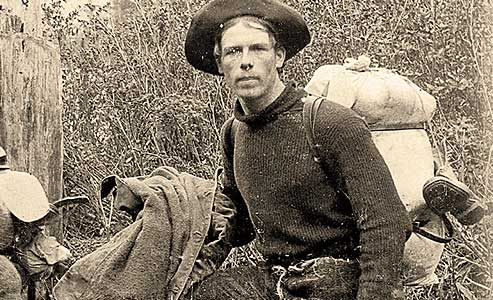
Jack London
LOVE OF LIFE
"This out of all will remain--
They have lived and have tossed:
So much of the game will be gain,
Though the gold of the dice has been lost."
They limped painfully down the bank, and once the foremost of the two men
staggered among the rough-strewn rocks. They were tired and weak, and
their faces had the drawn expression of patience which comes of hardship
long endured. They were heavily burdened with blanket packs which were
strapped to their shoulders. Head-straps, passing across the forehead,
helped support these packs. Each man carried a rifle. They walked in a
stooped posture, the shoulders well forward, the head still farther
forward, the eyes bent upon the ground.
"I wish we had just about two of them cartridges that's layin' in that
cache of ourn," said the second man.
His voice was utterly and drearily expressionless. He spoke without
enthusiasm; and the first man, limping into the milky stream that foamed
over the rocks, vouchsafed no reply.
The other man followed at his heels. They did not remove their
foot-gear, though the water was icy cold--so cold that their ankles ached
and their feet went numb. In places the water dashed against their
knees, and both men staggered for footing.
The man who followed slipped on a smooth boulder, nearly fell, but
recovered himself with a violent effort, at the same time uttering a
sharp exclamation of pain. He seemed faint and dizzy and put out his
free hand while he reeled, as though seeking support against the air.
When he had steadied himself he stepped forward, but reeled again and
nearly fell. Then he stood still and looked at the other man, who had
never turned his head.
The man stood still for fully a minute, as though debating with himself.
Then he called out:
"I say, Bill, I've sprained my ankle."
Bill staggered on through the milky water. He did not look around. The
man watched him go, and though his face was expressionless as ever, his
eyes were like the eyes of a wounded deer.
The other man limped up the farther bank and continued straight on
without looking back. The man in the stream watched him. His lips
trembled a little, so that the rough thatch of brown hair which covered
them was visibly agitated. His tongue even strayed out to moisten them.
"Bill!" he cried out.
It was the pleading cry of a strong man in distress, but Bill's head did
not turn. The man watched him go, limping grotesquely and lurching
forward with stammering gait up the slow slope toward the soft sky-line
of the low-lying hill. He watched him go till he passed over the crest
and disappeared. Then he turned his gaze and slowly took in the circle
of the world that remained to him now that Bill was gone.
Near the horizon the sun was smouldering dimly, almost obscured by
formless mists and vapors, which gave an impression of mass and density
without outline or tangibility. The man pulled out his watch, the while
resting his weight on one leg. It was four o'clock, and as the season
was near the last of July or first of August,--he did not know the
precise date within a week or two,--he knew that the sun roughly marked
the northwest. He looked to the south and knew that somewhere beyond
those bleak hills lay the Great Bear Lake; also, he knew that in that
direction the Arctic Circle cut its forbidding way across the Canadian
Barrens. This stream in which he stood was a feeder to the Coppermine
River, which in turn flowed north and emptied into Coronation Gulf and
the Arctic Ocean. He had never been there, but he had seen it, once, on
a Hudson Bay Company chart.
Again his gaze completed the circle of the world about him. It was not a
heartening spectacle. Everywhere was soft sky-line. The hills were all
low-lying. There were no trees, no shrubs, no grasses--naught but a
tremendous and terrible desolation that sent fear swiftly dawning into
his eyes.
"Bill!" he whispered, once and twice; "Bill!"
He cowered in the midst of the milky water, as though the vastness were
pressing in upon him with overwhelming force, brutally crushing him with
its complacent awfulness. He began to shake as with an ague-fit, till
the gun fell from his hand with a splash. This served to rouse him. He
fought with his fear and pulled himself together, groping in the water
and recovering the weapon. He hitched his pack farther over on his left
shoulder, so as to take a portion of its weight from off the injured
ankle. Then he proceeded, slowly and carefully, wincing with pain, to
the bank.
27. listopadu 2018
Za zrcadlem

Svet v králičí díře - Nad Berounkou pod Tetínem
http://prekladanipvk.blogspot.com/2009_02_22_archive.html
Humří čtverylka
http://prekladanipvk.blogspot.com/2009/10/prekladatel-v-kraji-divu.html
Lysperní jezleni
http://prekladanipvk.blogspot.com/2011/11/lysperni-jezleni-ti-druzi.html
https://prekladanipvk.blogspot.com/2014/12/slovnik-filharmonickeho-slangu.html
CHAPTER II
The Garden of Live Flowers
`I should see the garden far better,' said Alice to herself, `if I could get to the top of that hill: and here's a path that leads straight to it -- at least, no, it doesn't do that -- ' (after going a few yards along the path, and turning several sharp corners), `but I suppose it will at last. But how curiously it twists! It's more like a corkscrew than a path! Well, THIS turn goes to the hill, I suppose -- no, it doesn't! This goes straight back to the house! Well then, I'll try it the other way.'
And so she did: wandering up and down, and trying turn after turn, but always coming back to the house, do what she would. Indeed, once, when she turned a corner rather more quickly than usual, she ran against it before she could stop herself.
`It's no use talking about it," Alice said, looking up at the house and pretending it was arguing with her. `I'm NOT going in again yet. I know I should have to get through the Looking-glass again -- back into the old room -- and there'd be an end of all my adventures!'
So, resolutely turning back upon the house, she set out once more down the path, determined to keep straight on till she got to the hill. For a few minutes all went on well, and she was just saying, `I really SHALL do it this time -- ' when the path gave a sudden twist and shook itself (as she described it afterwards), and the next moment she found herself actually walking in at the door.
'Oh, it's too bad!' she cried. `I never saw such a house for getting in the way! Never!'
However, there was the hill full in sight, so there was nothing to be done but start again. This time she came upon a large flower-bed, with a border of daisies, and a willow-tree growing in the middle.
`O Tiger-lily,' said Alice, addressing herself to one that was waving gracefully about in the wind, `I WISH you could talk!' `We CAN talk,' said the Tiger-lily: `when there's anybody worth talking to."
Alice was so astonished that she could not speak for a minute: it quite seemed to take her breath away. At length, as the Tiger-lily only went on waving about, she spoke again, in a timid voice -- almost in a whisper. `And can ALL the flowers talk?'
`As well as YOU can,' said the Tiger-lily. `And a great deal louder.'
`It isn't manners for us to begin, you know,' said the Rose, `and I really was wondering when you'd speak! Said I to myself, "Her face has got SOME sense in it, thought it's not a clever one!" Still, you're the right colour, and that goes a long way.'
`I don't care about the colour,' the Tiger-lily remarked. `If only her petals curled up a little more, she'd be all right.'
Alice didn't like being criticised, so she began asking questions. `Aren't you sometimes frightened at being planted out here, with nobody to take care of you?'
`There's the tree in the middle,' said the Rose: `what else is it good for?'
`But what could it do, if any danger came?' Alice asked.
`It says "Bough-wough!" cried a Daisy: `that's why its branches are called boughs!'
`Didn't you know THAT?' cried another Daisy, and here they all began shouting together, till the air seemed quite full of littleshrill voices. `Silence, every one of you!' cried the Tigerlily, waving itself passionately from side to side, and trembling with excitement. `They know I can't get at them!' it panted, bending its quivering head towards Alice, `or they wouldn't dare to do it!'
`Never mind!' Alice said in a soothing tone, and stooping down to the daisies, who were just beginning again, she whispered, `If you don't hold your tongues, I'll pick you!'
There was silence in a moment, and several of the pink daisies turned white.
`That's right!' said the Tiger-lily. `The daisies are worst of all. When one speaks, they all begin together, and it's enough to make one wither to hear the way they go on!'
`How is it you can all talk so nicely?' Alice said, hoping to get it into a better temper by a compliment. `I've been in many gardens before, but none of the flowers could talk.'
`Put your hand down, and feel the ground,' said the Tiger-lily. `Then you'll know why.
Alice did so. `It's very hard,' she said, `but I don't see what that has to do with it.'
`In most gardens,' the Tiger-lily said, `they make the beds too soft -- so that the flowers are always asleep.'
This sounded a very good reason, and Alice was quite pleased to know it. `I never thought of that before!' she said.
`It's MY opinion that you never think AT ALL,' the Rose said in a rather severe tone.
`I never say anybody that looked stupider,' a Violet said, so suddenly, that Alice quite jumped; for it hadn't spoken before.
`Hold YOUR tongue!' cried the Tiger-lily. `As if YOU ever saw anybody! You keep your head under the leaves, and snore away there, till you know no more what's going on in the world, that if you were a bud!'
`Are there any more people in the garden besides me?' Alice said, not choosing to notice the Rose's last remark.
`There's one other flower in the garden that can move about like you,' said the Rose. `I wonder how you do it -- ' (`You're always wondering,' said the Tiger-lily), `but she's more bushy than you are.'
`Is she like me?' Alice asked eagerly, for the thought crossed her mind, `There's another little girl in the garden, somewhere!'
`Well, she has the same awkward shape as you,' the Rose said, `but she's redder -- and her petals are shorter, I think.'
`Her petals are done up close, almost like a dahlia,' the Tiger-lily interrupted: `not tumbled about anyhow, like yours.'
`But that's not YOUR fault,' the Rose added kindly: `you're beginning to fade, you know -- and then one can't help one's petals getting a little untidy.'
Alice didn't like this idea at all: so, to change the subject, she asked `Does she ever come out here?'
`I daresay you'll see her soon,' said the Rose. `She's one of the thorny kind.'
`Where does she wear the thorns?' Alice asked with some curiosity.
`Why all round her head, of course,' the Rose replied. `I was wondering YOU hadn't got some too. I thought it was the regular rule.'
`She's coming!' cried the Larkspur. `I hear her footstep, thump, thump, thump, along the gravel-walk!'
Alice looked round eagerly, and found that it was the Red Queen. `She's grown a good deal!' was her first remark. She had indeed: when Alice first found her in the ashes, she had been only three inches high -- and here she was, half a head taller than Alice herself!
`It's the fresh air that does it,' said the Rose: `wonderfully fine air it is, out here.'
"I think I'll go and meet her,' said Alice, for, though the flowers were interesting enough, she felt that it would be far grander to have a talk with a real Queen.
`You can't possibly do that,' said the Rose: `_I_ should advise you to walk the other way.'
This sounded nonsense to Alice, so she said nothing, but set off at once towards the Red Queen. To her surprise, she lost sight of her in a moment, and found herself walking in at the front-door again.
A little provoked, she drew back, and after looking everywhere for the queen (whom she spied out at last, a long way off), she thought she would try the plan, this time, of walking in the opposite direction.
It succeeded beautifully. She had not been walking a minute before she found herself face to face with the Red Queen, and full in sight of the hill she had been so long aiming at.
Přihlásit se k odběru:
Příspěvky (Atom)